

Was Spinosaurus Really a ‘Hell Heron’? Digging Into the Star of Netflix’s ‘The Dinosaurs’
/https://tf-cmsv2-smithsonianmag-media.s3.amazonaws.com/filer_public/33/a5/33a5dde2-04c6-49ec-8048-9327ee3233bb/four_spinosaurids_by_abelov2014.jpg?ssl=1 "Was Spinosaurus Really a ‘Hell Heron’? Digging Into the Star of Netflix’s ‘The Dinosaurs’")
With an incredible sail and heavy bones that might have acted as ballast, Spinosaurus seems primed for snatching fish. The creature has long captivated the public, from its early mysteries to the recent discovery of a new species
:focal(1372x954:1373x955)/https://tf-cmsv2-smithsonianmag-media.s3.amazonaws.com/filer_public/33/a5/33a5dde2-04c6-49ec-8048-9327ee3233bb/four_spinosaurids_by_abelov2014.jpg)
Spinosaurus was the largest and most aquatic of the spinosaurs, a group of dinosaurs with crocodilian snouts.
Андрей Белов via Wikimedia Commons under CC BY 3.0
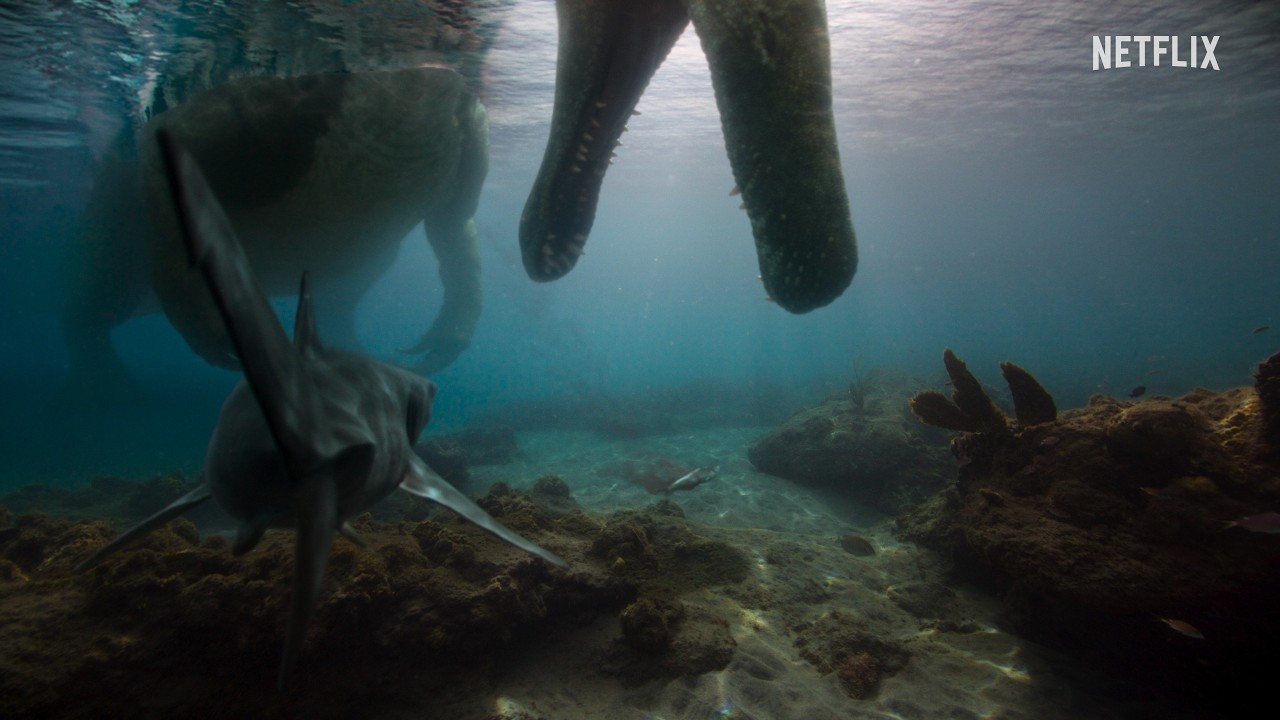
Standing in the shallows of an ancient sea, a large Spinosaurus catches a fish, drops it into the water and waits. Before long, the blood attracts a shark, which swims right into the dinosaur’s gaping jaws. Just a snap, a shake and a swallow, and the shark is gone.
This imaginary scene, brought to life in CGI, has been a chief draw to Netflix’s new documentary series The Dinosaurs. And for good reason: Spinosaurus is a star in its own right, estimated to have stretched more than 46 feet from the tip of its crocodilian snout to the end of its paddle-shaped tail. Though comparable in size to the land-based, carnivorous Giganotosaurus and iconic T. rex, the sail-backed Spinosaurus had a taste for seafood—it was an adept fish-eater.
However, experts are quick to point out that Spinosaurus didn’t necessarily use bait to hunt. Netflix’s dramatic scene is speculative. “There is no evidence for such behavior,” says Johns Hopkins University paleontologist Matteo Fabbri, who has researched Spinosaurus behavior. The show’s creators, he suggests, simply had the dinosaur enact a more sensational version of modern green herons’ strategy of sometimes dropping twigs or feathers in the water to entice little fish.
Such speculation is possible because Spinosaurus is a dinosaur surrounded by questions—one whose popularity outstrips what experts actually know about the animal. It has made repeat appearances in the Jurassic Park franchise, playing the big bad in 2001’s Jurassic Park III and munching on mercenaries in last year’s Jurassic World: Rebirth. But in reality, paleontologists are still debating how often Spinosaurus swam, whether it hunted on the shore or in the water, and what in the world the dinosaur had such an impressive sail for.
Spinosaurus vs Shark | Deadly Ocean Ambush | The Dinosaurs | Netflix
For its entire scientific history, Spinosaurus has been an enigma. The first Spinosaurus fossils to be described by researchers were found in the Sahara Desert’s Cretaceous rocks and initially mistaken for fish teeth. It wasn’t until 1912, with a discovery of strange bones in Egypt, that experts got a better look. German paleontologist Ernst Stromer analyzed the collection of bones, which included a lower jaw fitted with the same strange, fishlike teeth found in the desert. Individual vertebrae supported a fan-shaped array of incredibly tall neural spines, which must have formed some kind of sail on the animal’s back. Opting for literalism, Stromer named the dinosaur Spinosaurus aegyptiacus.
The idea of a carnivorous dinosaur with a sail as tall as a person stuck in paleontologists’ imaginations. Even after the fossils gathered by Stromer were destroyed during a British air raid on Munich in 1944, the dinosaur remained legendary and was a common inclusion in children’s books—often looking like an Allosaurus with a huge sail. Though scientists had no remains left to study, the dinosaur’s fame continued to spread.
No one has found a complete Spinosaurus yet, so what’s known of the creature comes from several Spinosaurus fossils and comparisons with related dinosaurs. Sereno, Paul et al., eLife, 2022, via Wikimedia Commons under CC BY 4.0/https://tf-cmsv2-smithsonianmag-media.s3.amazonaws.com/filer_public/ba/28/ba28898d-3e4a-4326-b903-9fe027a200a4/digital_skeletal_reconstruction_of_spinosaurus.png)
New discoveries soon began to change that story. Fragmentary Spinosaurus fossils were found in Morocco in the 1980s, and the unearthing of related dinosaurs forced paleontologists to rethink the appearance of the great “spine lizard.” For instance, the fossil gut contents of a strange dinosaur named Baryonyx—found in England and described in 1986—indicated that the animal had dined on both fish and a baby dinosaur soon before its own death. Baryonyx was not an unheard-of form of dinosaur, however. The new find shared key traits with Spinosaurus, indicating that the long-lost creature was more fish snatcher than flesh ripper. Both dinosaurs were placed under the “spinosaurs” umbrella.
Now, paleontologists have named around two dozen different spinosaur species, uncovered in such far-flung places as England, Laos, Brazil and China. Between about 94 million and 140 million years ago, these creatures thrived across the planet. “Not all spinosaurs were giant, semi-aquatic animals like Spinosaurus,” notes the Jaume I University paleontologist Andrés Santos-Cubedo. Some, such as Baryonyx and the large “crocodile mimic” Suchomimus, were more land-based hunters, Santos-Cubedo notes, while Spinosaurus and other sail-backed forms like the “fish hunter” Ichthyovenator had more specializations for life in water. The group represents a range of habitats and prey preferences rather than a one-size-fits-all approach.
Fun fact: The “heavy claw” of Baryonyx
The spinosaur Baryonyx had a massive claw that it might have used to hook prey, such as fish. A fossil claw from the dinosaur discovered in 1983 measured 12.2 inches along its outer curved edge.
In 2014, a partial skeleton of Spinosaurus found in eastern Morocco made the creature seem even weirder. The legs were stubby compared with the rest of the carnivore’s body, its tail had elongated spines that made it resemble a paddle and its bones were extra dense—like those of early whales, which used their skeletons as ballast to help them stay underwater.
With that discovery, Spinosaurus quickly went from a mystery to a creature surrounded by debate—even the experts who published the 2014 paper disagreed about how much time Spinosaurus spent in the water. “The debate is ongoing,” Fabbri says. Some experts envision Spinosaurus swimming like a crocodile and occasionally capturing food while paddling around. Others suggest that it stayed close to shore and waded to feed like a heron. “I believe both sides agree that this animal was spending a lot of time in the water,” Fabbri says, with the controversy centered around the finer details.
To date, he adds, the bulk of the evidence suggests that Spinosaurus was a strong swimmer, not merely a wader. In addition to the major clue from its bone density, geochemical hints from the dinosaur’s teeth indicate that it was spending more time in the water than other carnivorous dinosaurs did. Further, Spinosaurus has typically been found in the same fossil beds as large fish and crocodiles, Fabbri says, signaling its presence in vast water that was deep enough for it to swim in. Other experts insist on the heron comparison, though Fabbri says this idea ignores some of the ways Spinosaurus was suited for moving through water.
These bones, detailed with the first scientific description of Spinosaurus in 1915, were destroyed during World War II, leaving paleontologists with no trace of the dinosaur until new discoveries came decades later./https://tf-cmsv2-smithsonianmag-media.s3.amazonaws.com/filer_public/eb/12/eb126995-eab4-4ffd-81ae-d7d85407edb0/spinosaurus_holotype.jpg)
Better skeletal material would go a long way toward investigating the possibilities. The 2014 Spinosaurus revealed unknown parts of the dinosaur’s skeleton, but it remains very incomplete. Much of what we think of as Spinosaurus is based on comparisons with related spinosaurs, especially the dinosaur’s arms and claws. “Confirming the aquatic hypothesis will require more realistic biomechanical evidence,” Santos-Cubedo says, which would allow experts to not only compare body proportions related to swimming but create better scientific models to assess how well Spinosaurus swam around the prehistoric pool.
Given the dinosaur’s popularity, such debates will undoubtedly continue, especially now that a new Spinosaurus species is making headlines. The creature, Spinosaurus mirabilis, was described in Science in February, based on a skull with an impressive crest. The authors of the new study argue that this dinosaur was more of a heronlike hunter, because it was found relatively inland from the prehistoric coast. Still, paleontologists cannot truly assess the new species’ swimming abilities until they find the rest of its skeleton. Perhaps the constantly embattled T. rex could offer some empathy—everything from the dinosaur’s running speed to its feeding habits has fueled debates among fans and experts alike.
“I believe that there is still a lot to learn about spinosaurs in general and their evolution towards aquatic environments,” Fabbri says. After all, it took tens of millions of years of evolutionary change to spin off this titanic reptile with a crocodile smile.

Advertisement - Continue Reading Below
Latest


Advertisement - Continue Reading Below