

Spectators Flocked to the Artemis 2 Launch to Witness History Being Made. One Awed Viewer Called It ‘the Best Thing Ever’
/https://tf-cmsv2-smithsonianmag-media.s3.amazonaws.com/filer_public/7f/59/7f59693c-eb2f-476d-a2d9-e0ff653d0bdf/pxl_20260401_223707602.jpg?ssl=1 "Spectators Flocked to the Artemis 2 Launch to Witness History Being Made. One Awed Viewer Called It ‘the Best Thing Ever’")
Wednesday evening, a human mission to the moon lifted off for the first time in more than 50 years. These 13 photographs capture what it was like to experience the moment
:focal(2040x1535:2041x1536)/https://tf-cmsv2-smithsonianmag-media.s3.amazonaws.com/filer_public/7f/59/7f59693c-eb2f-476d-a2d9-e0ff653d0bdf/pxl_20260401_223707602.jpg)
Onlookers captured photos and videos as the Space Launch System rocket carrying the Artemis 2 crew’s Orion spacecraft “Integrity” lifted off at 6:35 p.m. Eastern time on April 1.
Amber Ballard
You could see it first. Steam billowed beneath the enormous orange rocket, and a blinding plume of exhaust trailed below as it lifted off the ground.
Then, you could hear it. About a minute after takeoff, the sound of several tons of rocket propellant burning every second rumbled in my ears and vibrated in my chest. The crowd around me—which had just been cheering wildly—suddenly went silent, peering upward in awe as the 322-foot-tall rocket, the most powerful to ever carry humans, dwindled to a speck of light in the azure sky.
“That is the best thing ever,” said Shawna Mack, who had driven from Kentucky to see the launch. “I’ve been waiting my whole life for this.” Her 20-year-old son, Wyatt, stood beside her, wiping his eyes. “We are realizing the dream of millennia,” he said.
Shawna and Wyatt were among the hundreds of thousands who made a pilgrimage to Florida’s Space Coast to witness the launch of NASA’s Artemis 2 mission on Wednesday. The rocket’s liftoff initiated a historic journey to the moon with humans on board, something that hasn’t happened in more than five decades.
People on the A. Max Brewer Bridge celebrate the launch of Artemis 2, which will carry four astronauts on a lunar flyby. Gerardo Mora / Getty Images/https://tf-cmsv2-smithsonianmag-media.s3.amazonaws.com/filer_public/f7/4b/f74b9c2e-fecc-4874-a73d-e5adb87fc1f8/gettyimages-2269445026.jpg)
People of all ages traveled to witness the launch, which is the first since 1972 to send humans beyond low-Earth orbit. Gerardo Mora / Getty Images/https://tf-cmsv2-smithsonianmag-media.s3.amazonaws.com/filer_public/0a/38/0a3885a4-c3cc-4705-8362-0e8f99538fe3/gettyimages-2269446263.jpg)
As the mission’s four-person crew—NASA astronauts Reid Wiseman, Victor Glover and Christina Koch and Canadian astronaut Jeremy Hansen—made final preparations in the hours and days leading up to their trip, spaceflight enthusiasts flocked to the area. I stood surrounded by people on the A. Max Brewer Bridge in Titusville, Florida, about 11 miles from the Kennedy Space Center launchpad. Some had staked out their spots early, camping on the bridge since Tuesday morning.
The astronauts, currently in Earth orbit, are preparing for a crucial step that will happen about 25 hours into the mission: the translunar injection, an engine burn to propel them toward the moon. During their ten-day flight around the moon and back, the crew is expected to journey farther from Earth than any humans have before, reaching 252,799 miles on day six.
Did you know? A historic trip to the moon
Artemis 2’s four astronauts are the first to travel aboard the Orion spacecraft, a crew capsule that was tested in 2022 during Artemis 1. That mission sent Orion on a 25-day trip as engineers monitored how it withstood the journey around the moon and, crucially, the return through Earth’s atmosphere.
The Artemis 2 crew has continually expressed in press conferences that they view their mission as a stepping stone to wider human exploration of the solar system. Collaboration between nations, they have emphasized, is key to success in space, and they say they are undertaking this journey on behalf of the entire world.
Those feelings were reflected among the crowd of spectators, many of whom had traveled long distances for the event. John Town, a 73-year-old former university administrator, came from West Yorkshire, England, to see Artemis 2 launch. “You don’t often get to see people blasted into space,” he said. “They’ll see bits of space where no one’s ever been.”
“It’s an opportunity to be a part of history,” said Julius Reckord, who drove with his wife from Houston. He remembers the first time he went to an airport at 5 years old, when he was so amazed by the flying machines that he developed a lifelong love of aerospace.
Joseph Buchman of Utah watched the Artemis 2 launch with the same 1998 Roadtrek he had driven to witness the final space shuttle launch, in 2011. Now, the vehicle has 410,000 miles on it. Jay Bennett/https://tf-cmsv2-smithsonianmag-media.s3.amazonaws.com/filer_public/71/bb/71bb2f0a-6529-4a96-a69d-10252b70752f/img_2060.jpg)
John Town, 73, traveled from England to see the launch. He slept in his car the night before. Jay Bennett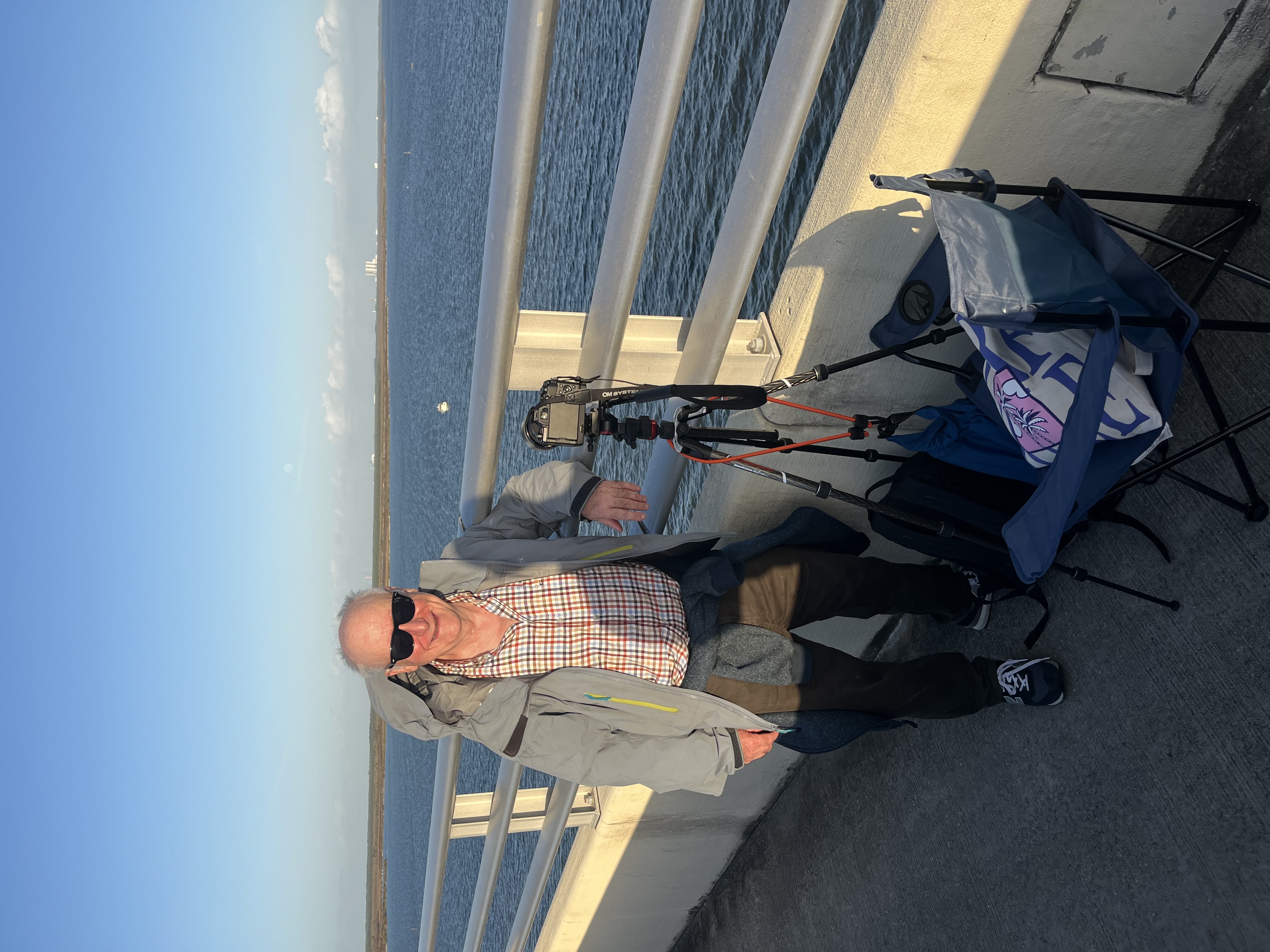
Chris Drew of South Florida spent the night on the A. Max Brewer Bridge to secure his spot for Wednesday evening’s launch. Jay Bennett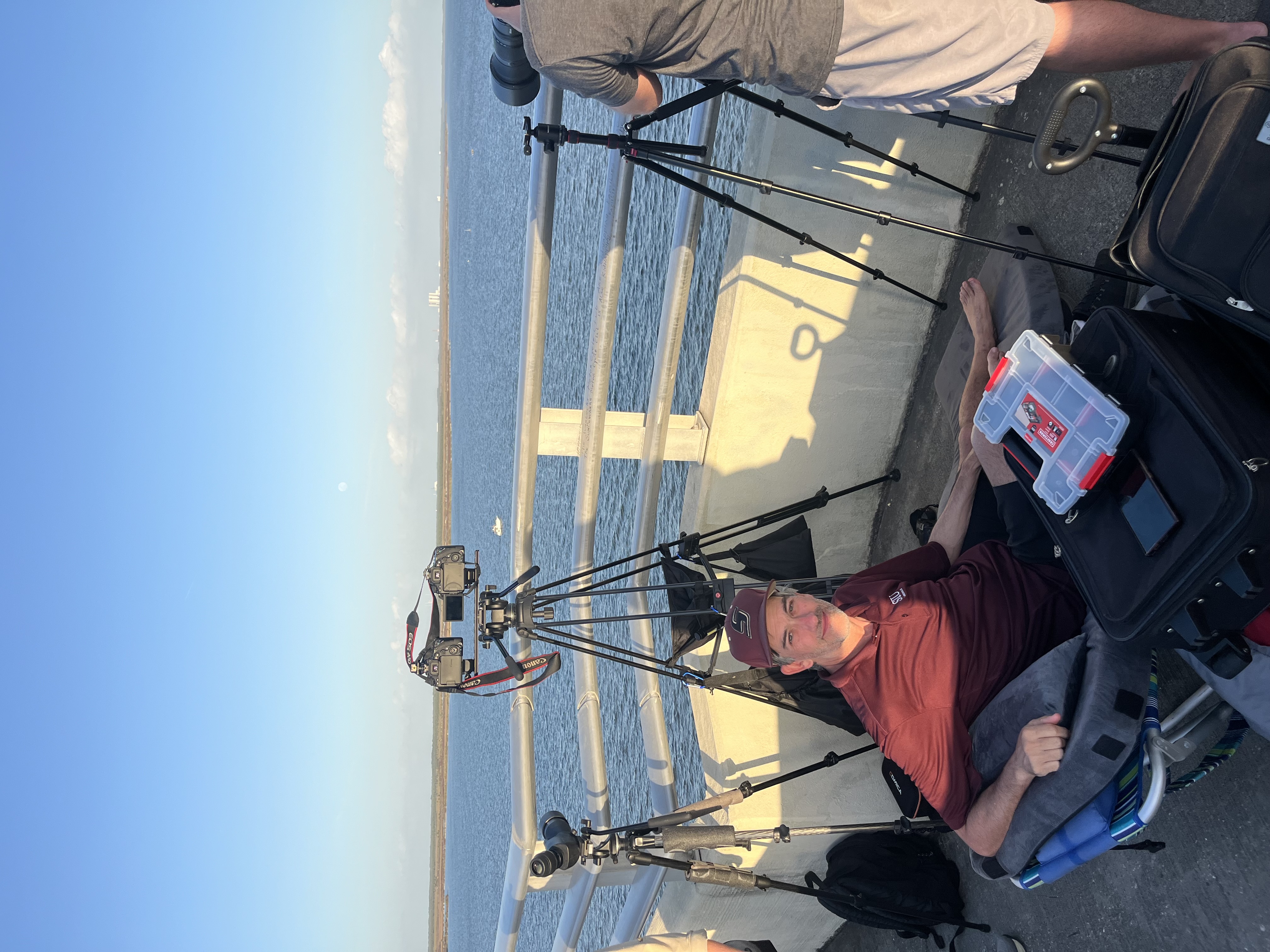
Leading up to the launch, a festival-like atmosphere developed along the bridge and in the surrounding parks, with spectators grilling food and cranking tunes such as “Dancing in the Moonlight” by King Harvest and “Rocket Man” by Elton John. People passed around Artemis 1 launch videos like Grateful Dead tapes. They discussed questions of space philosophy, culture and history—such as whether encountering an alien species would inevitably lead to violence, whether “Deep Space Nine” is a superior Star Trek series to “The Next Generation,” and why NASA had removed the line indicating the vulva on the nude figure of a woman inscribed on the Pioneer Plaque launched to space in 1972.
Spectators stand in line at a food truck on the day of the launch. In the parks along Florida’s coast near the Kennedy Space Center, the gatherings took on a festival-like atmosphere. Nick Mahan/https://tf-cmsv2-smithsonianmag-media.s3.amazonaws.com/filer_public/b3/23/b32316d5-2174-4470-9ae8-ed9b2793b20f/pxl_20260401_193002549.jpg)
Binoculars in hand, Cornell Odom of California waits for the Artemis 2 launch. Gerardo Mora / Getty Images/https://tf-cmsv2-smithsonianmag-media.s3.amazonaws.com/filer_public/e8/46/e846d6f0-7f49-41ab-a09e-27f0ae1d8c84/gettyimages-2269439342.jpg)
Nick Mahan traveled from Cincinnati to see the launch. Amber Ballard/https://tf-cmsv2-smithsonianmag-media.s3.amazonaws.com/filer_public/85/73/8573e3ee-3d49-48de-85cc-c03287903204/pxl_20260401_222126036mp.jpg)
Crowds watch and photograph the launch of NASA’s Artemis 2 mission. Jay Bennett/https://tf-cmsv2-smithsonianmag-media.s3.amazonaws.com/filer_public/53/41/534162d6-e135-49c4-a2e5-6499646b213d/img_2187.jpg)
For many in attendance, the exploration of space represents a quasi-religious endeavor. They drew parallels between this mission, which is the first crewed mission of the Artemis lunar program, and Apollo 8, the first Apollo flight to bring astronauts around the moon.
The Artemis 2 astronauts will spend Easter on the far side of the moon, while Apollo 8’s crew famously read from the Book of Genesis to an estimated one billion listeners while in lunar orbit on Christmas Eve in 1968. “It’s quite literally another Christian holiday happening while they’re flying around the moon,” said Nick Mahan, who drove from outside Cincinnati and spent the night on the bridge.
Amber Ballard, a sign-language interpreter, school board official and part-time circus performer from Ohio, said that witnessing humans pushing the limits of exploration brings people together. “There’s so much negative in the world, and to see something positive, be part of something positive,” she said, “that’s what makes us unified.”
Artemis 2 will carry astronauts around the moon. Artemis 4, scheduled for 2028, will aim to land humans on the lunar surface. Gerardo Mora / Getty Images/https://tf-cmsv2-smithsonianmag-media.s3.amazonaws.com/filer_public/ed/03/ed03c38d-6316-43c9-85f0-b40ebda9e3c1/gettyimages-2269443329.jpg)
Approximately 400,000 spectators were expected to watch the event in person. Nick Mahan/https://tf-cmsv2-smithsonianmag-media.s3.amazonaws.com/filer_public/3e/ed/3eedac55-f509-4601-8caa-7fe92a59ad5e/1000061368.jpg)
Birds fly past the Space Launch System rocket as it takes off. Kennedy Space Center is co-located with the Merritt Island National Wildlife Refuge. Joe Raedle / Getty Images/https://tf-cmsv2-smithsonianmag-media.s3.amazonaws.com/filer_public/a3/51/a35169bc-e84f-47fd-9bbb-38113e8614c8/gettyimages-2269452782.jpg)
About an hour after launch, the full moon rose in the east and hovered above the launchpad. I thought about the national wildlife refuge that surrounds Kennedy Space Center, where songbirds such as warblers and parulas are now arriving after migrations from Central and South America. Meanwhile, shorebirds like pelicans and sandpipers are departing for breeding grounds far to the north.
As I walked down off the bridge, I wished safe travels to all beings embarking on long journeys.

Advertisement - Continue Reading Below
Latest


Advertisement - Continue Reading Below